• Legal

What Missed Calls Actually Cost Your Law Firm (With Real Numbers)

Every law firm owner knows that missed calls are bad for business. But almost none of them know exactly how bad — because missed calls are the one line item that never shows up on a P&L statement.

You cannot see the cases you did not sign. You cannot track the revenue from the client who called at 7 PM, reached voicemail, and hired your competitor by 7:15.

The cost is invisible. Which is exactly what makes it so dangerous.

This post puts real numbers on the problem — the actual math that shows what unanswered calls are costing your firm right now.

How Many Calls Your Firm Is Actually Missing

The data on law firm call answering rates is consistent across multiple studies — and the numbers are worse than most firm owners assume.

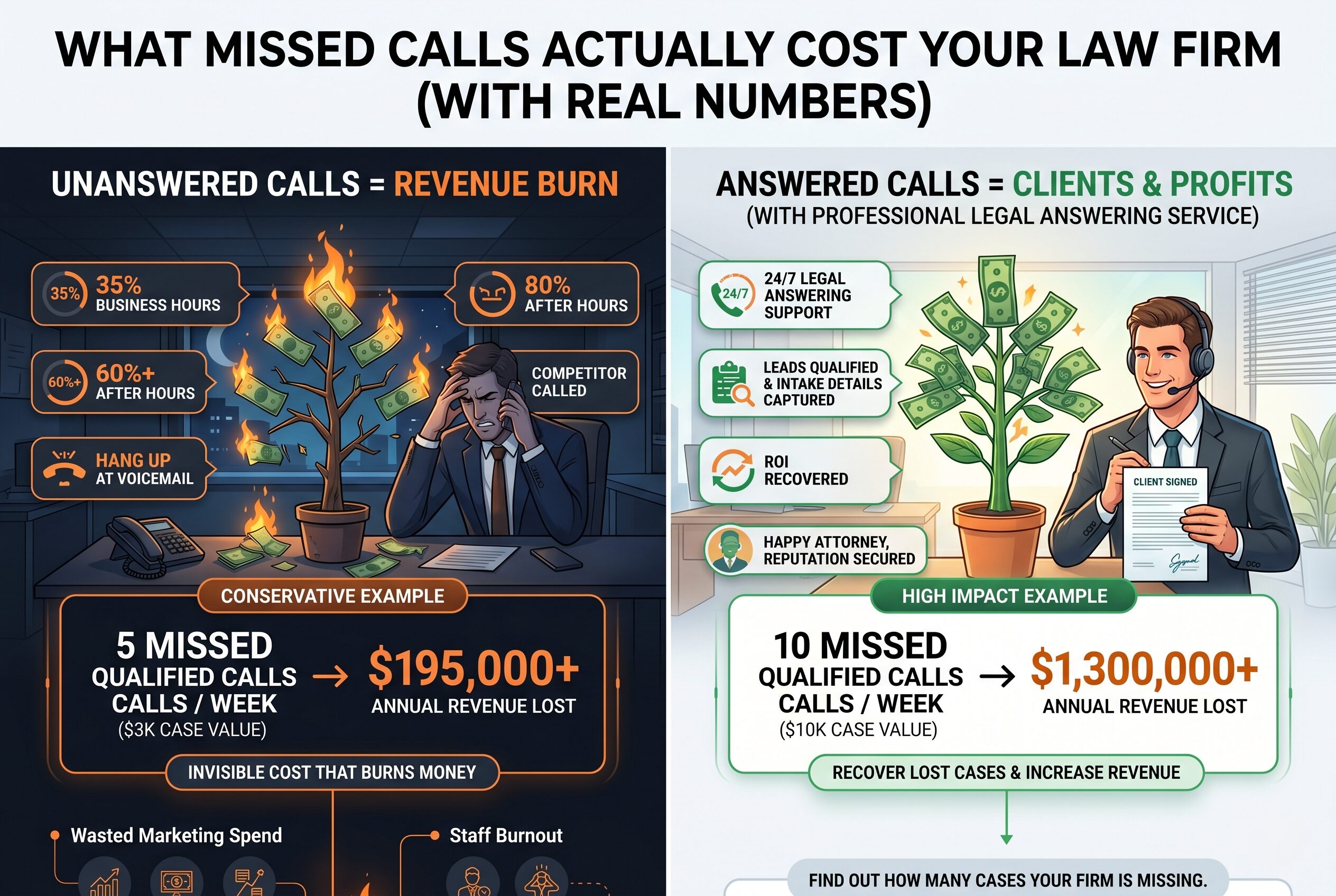
62.2%
of small business calls go to voicemail or no answer
35%
of law firm calls missed during business hours (Clio)
60%+
of calls missed after hours at most firms
80%
of callers who reach voicemail hang up without leaving a message

For a law firm receiving 20 calls per day, the math is straightforward. During business hours, you are missing roughly 7 of those calls. After hours and on weekends, you are missing 12 or more. That is potentially 50 to 80 missed calls per week, depending on your volume.

Among those who do leave a voicemail, 67% of people admit to ignoring voicemails even from known contacts. Among unknown numbers, only 18% of voicemails are ever listened to. Your potential clients aren't waiting for a callback. They're already calling the next firm.

The Revenue Math Nobody Wants to Do

Here is where the numbers get uncomfortable. Not every missed call is a potential client, but a meaningful percentage of them are. Industry conversion rates for law firm calls range from 20% to 35% depending on practice area and lead quality.

Using conservative assumptions — 10 qualified missed calls per week, 25% conversion, $3,000 average case value — that is $390,000 per year in lost revenue. Here's the full breakdown across different firm sizes and practice areas:

Missed Qualified Calls/Wk Conversion Rate Avg Case Value Weekly Lost Revenue Annual Lost Revenue
5 25% $3,000 $3,750 $195,000
5 25% $10,000 $12,500 $650,000
10 25% $3,000 $7,500 $390,000
10 25% $10,000 $25,000 $1,300,000
15 25% $5,000 $18,750 $975,000

Conservative conversion rates used. Firms with strong marketing generating high-intent inbound calls often see 30–35% conversion rates, making these figures even higher.

For personal injury firms specifically, the numbers are even more stark. As we broke down in detail, a PI firm missing just 5 qualified calls per week at an average case value of $15,000 is leaving over $75,000 on the table annually. Many firms are missing far more than 5.

Attorney reviewing phone call logs and unanswered call data to calculate revenue loss

Most firms track ad spend and website traffic — but not the value of the calls they're already missing.

The Hidden Costs Beyond Lost Cases

Direct revenue loss is only part of the equation. Missed calls generate secondary costs that compound over time.

Wasted Marketing Spend

If your firm spends $5,000/month on marketing and misses 35% of the calls it generates, roughly $1,750 of your monthly marketing budget is effectively thrown away every single month.

Competitor Advantage

Research shows 62% of callers who don't reach a business call a competitor instead. In legal services, where 62–78% of clients hire the first attorney who speaks with them, a missed call is a transferred lead.

Reputation Damage

Callers who cannot reach your firm leave negative reviews, tell friends and family, and associate your firm with unreliability. Every unanswered call chips away at the reputation you've spent years building.

Staff Burnout

When your team returns to a queue of missed calls every morning, they spend their first productive hours playing catch-up. Many callbacks go to voicemail again, creating an endless cycle of phone tag.

When the Biggest Leaks Happen

Missed calls are not evenly distributed throughout the day. They cluster around predictable gaps that most firms ignore.

  • 6 PM – 8 AM

    After Hours — The Largest Gap

    Legal emergencies — arrests, accidents, domestic incidents — disproportionately happen in the evening and overnight. These callers are the most motivated and most likely to retain the first attorney they reach.

  • 12 PM – 1 PM

    Lunch Breaks

    Many potential clients call during their own lunch break — the only private moment in their workday. If your receptionist is also at lunch, those calls go unanswered.

  • Sat – Sun

    Weekends & Holidays

    Accidents, arrests, and family crises don't follow a Monday-to-Friday schedule. Firms without weekend coverage are invisible for roughly 30% of the calendar year.

  • Peak Hours

    High-Volume Periods

    When your phone lines are busy with existing calls, new callers get a busy signal or extended hold time. Studies show callers waiting more than 30 seconds are significantly more likely to hang up.

The firms that solve this problem don't do it with more staff or longer office hours. They do it with 24/7 professional answering that ensures every call, at any hour, reaches a live person trained to handle legal intake.

The Fix Is Simpler Than You Think

The solution to missed calls is not hiring more staff. A full-time receptionist costs $35,000 to $55,000 per year in salary and benefits, covers one shift per day, and still cannot answer calls during vacations, sick days, or when they are already on another line.

A professional law firm answering service provides 24/7 coverage with trained legal receptionists at a fraction of that cost. The best services capture intake details, qualify leads, schedule consultations, and deliver messages in real time — so your attorneys follow up with warm leads instead of cold callbacks.

The ROI Calculation Is Simple

If an answering service costs $300 to $500 per month and recovers even one additional case per month at a $3,000 to $15,000 case value, it pays for itself multiple times over. For most firms, the service recovers its cost within the first week of operation. See our pricing for plan details.

Law firm team implementing 24/7 answering service to stop missing after-hours calls

The firms recovering the most missed-call revenue aren't working longer hours — they're ensuring every call reaches a live person.

How to Measure Your Own Missed Call Cost

You don't need sophisticated analytics to estimate what missed calls are costing your firm. Use this four-step formula:

Your Missed Call Cost Formula
  • 1
    Check your missed call volume Pull call logs for the past 30 days. If unavailable, assume 35% of business-hours volume and 60% after hours.
  • 2
    Estimate qualified lead percentage For most firms, 40% to 60% of inbound calls are new potential clients. Exclude existing clients and vendors.
  • 3
    Apply a 25% conversion rate This is conservative. Firms with strong intake processes often convert 30–35% of qualified calls.
  • 4
    Multiply by your average case value If the number makes you uncomfortable, that's the point. Making it visible is the first step toward fixing it.

The Bottom Line

Missed calls do not show up in your CRM. They do not appear on your financial statements. They leave no trace except the cases you never signed and the revenue you never earned.

Your marketing is already doing its job. Your reputation is already generating calls. The only question is whether someone is there to answer them.

The average law firm is leaving six figures of annual revenue on the table through unanswered calls alone. For firms with higher case values or stronger marketing generating more inbound volume, the number is significantly higher.

Find Out What Missed Calls Are Costing Your Firm

Gabbyville's law firm answering service provides 24/7 live coverage with trained legal receptionists and bilingual support — included in every plan.

Book a Free Consultation

15–20 minutes · No obligation · No long-term contracts

Frequently Asked Questions

Research shows law firms miss approximately 35% of incoming calls during business hours and 60% or more after hours. For a firm receiving 20 calls per day, that translates to 50 to 80 missed calls per week, many of which are potential clients who will not call back.
The cost depends on your practice area and average case value. For personal injury firms, a single missed call can represent $5,000 to $50,000 in lost revenue. For criminal defense or family law firms, the range is typically $3,000 to $10,000. When you factor in the lifetime value of a client and their referral network, the true cost of one missed call is often much higher than the immediate case value.
In most cases, yes. A full-time receptionist costs $35,000 to $55,000 per year in salary and benefits, covers one shift during business hours, and is unavailable during vacations, sick days, and after hours. A professional law firm answering service provides 24/7 coverage with trained legal receptionists at a fraction of that cost, typically $300 to $500 per month depending on call volume.

Stop Losing Revenue to Unanswered Calls

Gabbyville's law firm answering service provides 24/7 live coverage with trained legal receptionists, bilingual support included. Book a free consultation to find out how many cases your firm is missing.

Book a Free Consultation →

15–20 minutes · No obligation · No long-term contracts


Last updated: May 2026

  • Blogs
  • Legal

Why Bilingual Answering Is No Longer Optional for Law Firms in 2026

A Spanish-speaking caller dials your law firm at 6:30 PM on a Tuesday. She was rear-ended on the highway two hours ago. Her neck hurts, the other driver's insurance company is already calling, and she needs legal help now.

Your phone rings. Your office is closed. The voicemail greeting plays in English only.

She hangs up. She calls the next firm on Google. That firm answers in Spanish. That firm signs the case.

This scenario is not hypothetical. It is happening at law firms across the country every single day — and the numbers behind it should concern every firm owner who is serious about growth.

The Numbers That Should Change Your Mind

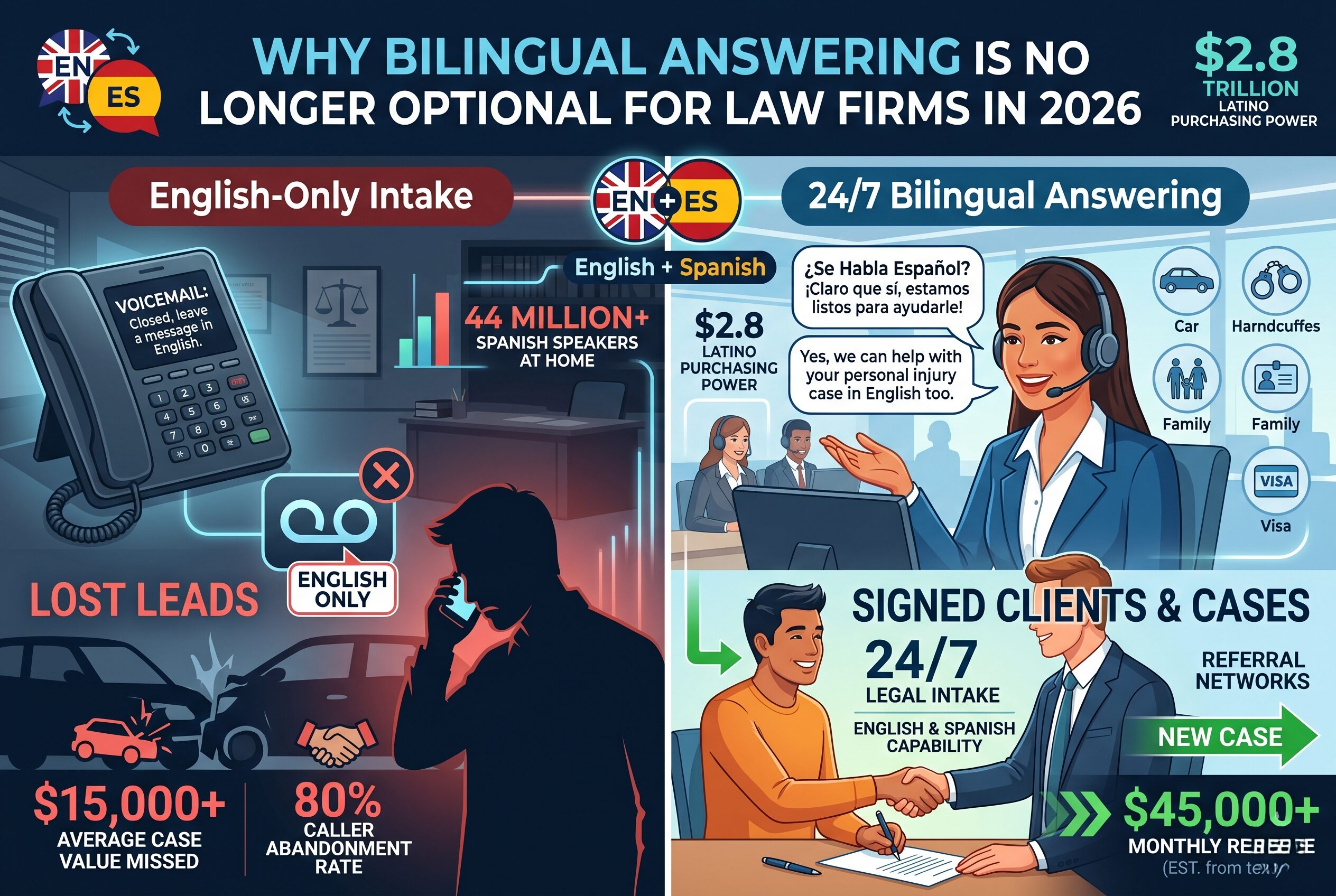
44.9M
Americans speak Spanish at home — 4× growth since 1970
$2.8T
U.S. Latino purchasing power projected in 2026
#2
The U.S. is the second-largest Spanish-speaking country in the world

According to the most recent U.S. Census Bureau data, 44.9 million Americans speak Spanish at home. That figure has grown more than fourfold since 1970, making the United States the second-largest Spanish-speaking country in the world behind Mexico.

For law firms, this translates directly into client volume. Hispanic Americans are involved in car accidents, workplace injuries, criminal cases, family disputes, and immigration matters at the same rates as any other demographic. The difference is that when they pick up the phone to call a lawyer, many of them are more comfortable communicating in Spanish — especially under stress. And stress is exactly when people call law firms.

Why the First 60 Seconds Matter More in Spanish

Legal intake is already a high-stakes conversation in any language. The caller is often scared, confused, or in pain. They are deciding in the first minute whether they trust this firm enough to share the details of their situation.

A Spanish-speaking caller who reaches an English-only receptionist faces an immediate decision: struggle through in a second language during one of the worst moments of their life, or hang up and find someone who speaks theirs. Most hang up. Research consistently shows that 80% of callers who reach voicemail do not leave a message — with a language barrier, that abandonment rate is even higher.

The firms that answer in Spanish do not just capture one additional case. They capture an entire referral network. Hispanic communities are tightly connected through family and social networks. One positive experience with a bilingual law firm generates word-of-mouth referrals that English-only marketing cannot replicate at any price.

Law firm receptionist speaking with Spanish-speaking client — bilingual legal intake in action

Bilingual intake doesn't just capture one case — it opens your firm to an entire referral network.

The Competitive Gap Is Still Wide Open

Despite the size of the Spanish-speaking market, most law firms still treat bilingual service as an afterthought. Some list "Se Habla Español" on their website but have no one available to actually take the call. Others rely on a single bilingual staff member who is only available during limited hours.

If your firm can answer calls in both English and Spanish, 24 hours a day, you are competing against firms that cannot. In practice areas like personal injury, criminal defense, family law, and immigration, this advantage compounds quickly.

The Revenue Opportunity — Personal Injury Alone

Spanish-language PI leads per month (major metro) 10–15 leads
Average PI case value $15,000
Close rate (conservative) 20%
Monthly revenue English-only firms never see $30K–$45K

What Bilingual Intake Actually Requires

Offering bilingual service is not as simple as hiring one Spanish-speaking employee. Genuine bilingual intake requires three things working together:

  • 1
    Coverage at all hours. Spanish-speaking callers do not limit their emergencies to business hours. A DUI arrest at midnight, a domestic violence incident on a Sunday, a car accident on a holiday — these all generate calls that need to be answered in the caller's language, immediately.
  • 2
    Legal vocabulary, not just conversational fluency. A receptionist answering for a criminal defense firm needs to understand terms like arraignment, bond hearing, and probable cause in both languages. A receptionist handling personal injury intake needs to capture details about liability, medical treatment, and insurance coverage.
  • 3
    Cultural competence. Tone, formality, and trust-building work differently across cultures. A bilingual receptionist trained in legal intake understands that a Spanish-speaking caller may need more reassurance, may be less familiar with the American legal system, and may have concerns that affect how they approach the conversation.

How the Best Firms Are Solving This

The firms getting this right are not trying to build bilingual capacity in-house. They are using answering services for law firms that include bilingual receptionists as a core feature rather than a premium add-on.

A full-time bilingual receptionist costs $40,000 to $55,000 per year in salary alone, covers one shift per day, takes vacations, and calls in sick. A professional bilingual answering service provides 24/7 coverage in both languages at a fraction of that cost — and the key differentiator is whether bilingual service is included or costs extra.

Many answering services charge a premium for Spanish-language calls, which creates a disincentive to route those calls properly. The best services include bilingual receptionists in every plan, treating Spanish-language intake as standard rather than optional.

The Practice Areas Where This Matters Most

Practice Area Why Bilingual Intake Is Critical
Personal Injury Hispanic workers are overrepresented in high-injury industries like construction, agriculture, and manufacturing. Accident calls come in at all hours and require immediate intake in the caller's language.
Criminal Defense Arrests happen at all hours. A Spanish-speaking family member calling about a DUI or assault charge at 2 AM needs a bilingual receptionist who understands the urgency and captures the right details.
Family Law Divorce, custody, and domestic violence matters are deeply personal. Callers are far more likely to share sensitive details when communicating in their most comfortable language.
Immigration By definition, immigration clients often have limited English proficiency. Spanish-language intake is not a nice-to-have — it is a functional requirement for serving this practice area.
Diverse law firm team reviewing bilingual intake process and Spanish-language call coverage strategy

Firms with structured bilingual intake outperform English-only competitors in every practice area with significant Hispanic populations.

What to Look for in a Bilingual Answering Service

If your firm is evaluating bilingual answering options, here is what separates adequate from excellent:

  • Bilingual service included in every plan — no extra charge. If a provider charges more for Spanish calls, your team will hesitate to route them, and leads will fall through the cracks.
  • Fluent, not just conversational. Legal intake requires precision. The difference between "he hit my car" and "he ran a red light and T-boned me at 45 miles per hour" matters for case evaluation — and the receptionist needs to capture that accurately in either language.
  • Coverage must be 24/7. If bilingual receptionists are only available during business hours, you are missing the highest-value window: evenings, weekends, and holidays when callers have no other option.
  • Integrated with your existing systems. Call notes, intake forms, and appointment scheduling should work the same way regardless of what language the call came in. Your attorneys should not need a separate workflow for Spanish-language leads.

Bilingual Answering Is Included in Every Gabbyville Plan

No premium charges for Spanish calls. No separate workflow. Just trained bilingual receptionists available 24/7 for your firm.

Book a Free Consultation

No obligation · 15–20 minutes · No long-term contracts

The Bottom Line

The math on bilingual answering is not complicated. Over 44 million people speak Spanish at home. Latino purchasing power exceeds $2.8 trillion. In practice areas like personal injury, criminal defense, family law, and immigration, Spanish-speaking callers represent a significant and growing share of potential clients.

Every firm that answers those calls in English only is leaving money on the table. Every firm that answers in both languages, 24 hours a day, with trained legal receptionists, is picking that money up.

The question is not whether bilingual answering matters. The question is how long your firm can afford to go without it.

Frequently Asked Questions

A single bilingual employee can only cover limited hours and is unavailable during vacations, sick days, and after-hours periods when many urgent legal calls come in. A bilingual answering service provides 24/7 coverage in both English and Spanish, ensuring no call is missed regardless of when it comes in or who is available in your office.
At Gabbyville, bilingual English-Spanish service is included with every plan at no additional cost. Some competitors charge a premium for Spanish-language calls, which can discourage proper call routing and cause you to lose leads. Look for a provider that treats bilingual service as standard, not optional.
Personal injury, criminal defense, family law, and immigration firms see the most immediate impact from bilingual intake. These practice areas involve high-stress, time-sensitive calls where callers need to communicate in their most comfortable language. However, any firm serving communities with significant Spanish-speaking populations will benefit.

Ready to Stop Missing Spanish-Language Leads?

Gabbyville includes bilingual English-Spanish receptionists with every plan — trained in legal intake, available 24/7, at no extra charge.

Book a Free Consultation →

15–20 minutes · No obligation · No long-term contracts


Last updated: May 2026

  • Blogs

AI vs Live Receptionists for Law Firms: Why the Answer Isn’t Either/Or

The virtual receptionist market has exploded. In 2026, there are dozens of AI-only answering services promising 24/7 coverage for as little as $29 per month. On the other end, live human receptionist services charge $250 to $1,000+ per month for trained agents who answer in your firm's name.

Law firms trying to decide between the two are asking the wrong question.

The real question isn't "AI or human?" It's "what does my caller actually need in the first 60 seconds of contact — and which solution delivers it?" The answer, for most law firms, is neither pure AI nor live-only. It's both, working together.

Law firm receptionist handling client intake call at professional desk

The best-performing law firms in 2026 aren't choosing between AI and human — they're using both.

Where Pure AI Excels

AI receptionist technology has improved dramatically. Modern AI receptionists sound natural, understand conversational language, and can handle straightforward tasks with impressive reliability.

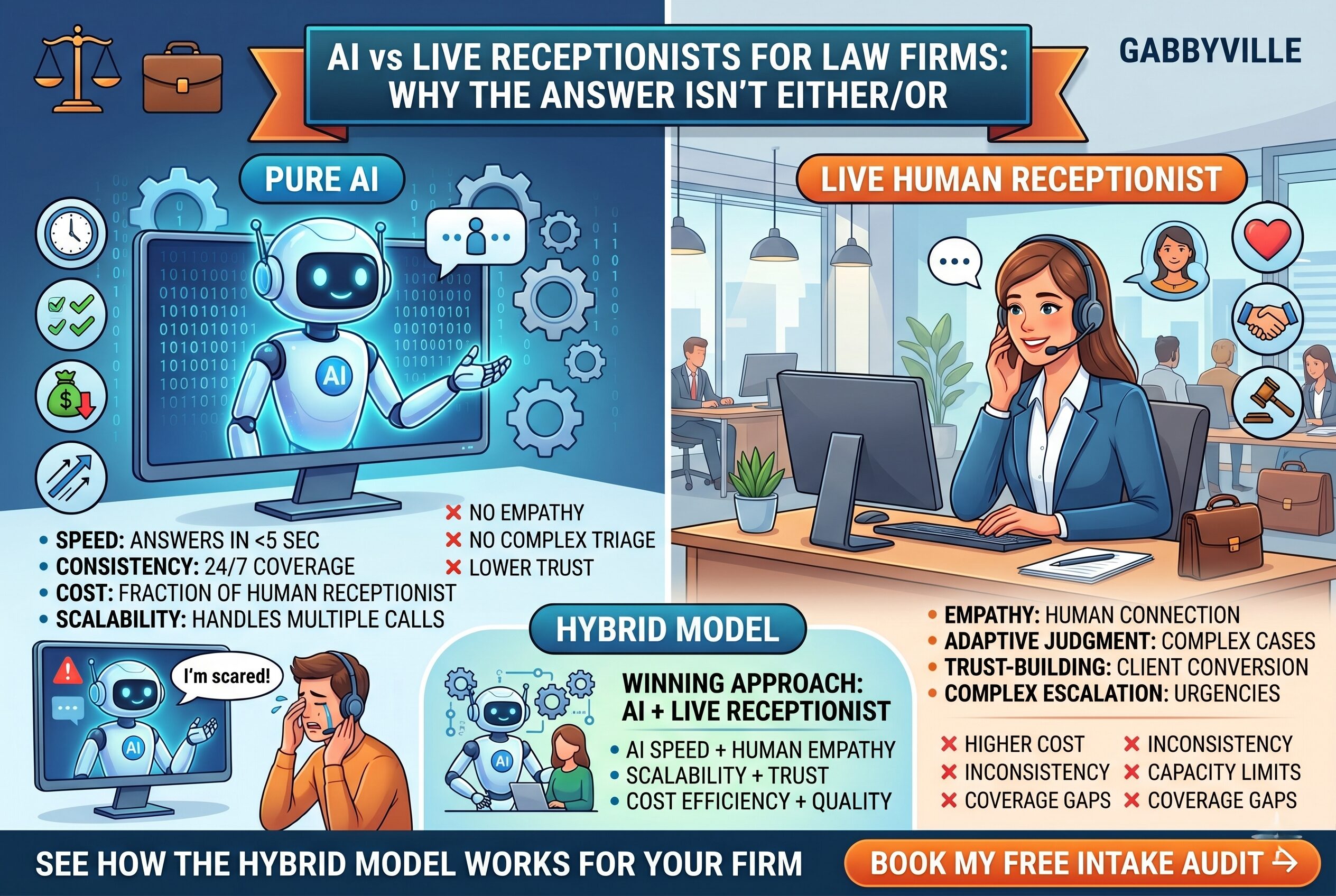
Where AI Wins
  • Speed. Answers in under 5 seconds, every time. No hold music, no ringing.
  • Consistency. Never has a bad day, never calls in sick, never rushes a 4:55 PM call.
  • Cost. $29–$199/month for unlimited calls — a fraction of human receptionist cost.
  • Scalability. Handles 20 simultaneous calls as easily as one. No busy signals, ever.
Where AI Fails
  • Empathy. Callers in crisis can tell the difference between scripted and genuine care.
  • Complex triage. AI follows its script — it can't hear urgency or make real-time judgment calls.
  • Trust. 84% of legal clients want to speak to a real person, not a bot.
  • Edge cases. The unpredictable 20% — crying callers, multi-party situations, ESL clients — breaks AI down.

Where Pure AI Fails — In Detail

Despite these strengths, pure AI has critical limitations that matter enormously in legal intake.

Research shows that 84% of legal clients want to speak to a real person, not a bot. That first phone call is where trust is built or lost. For criminal defense, family law, and personal injury — the human connection in those first 60 seconds can determine whether a prospect becomes a client.

A parent calling at midnight because their 19-year-old was just arrested doesn't need efficient data collection. They need to hear a calm, human voice that acknowledges their fear and guides them through what happens next. AI can simulate empathy through scripted phrases, but callers in crisis can tell the difference — and many will hang up.

And in law, that unpredictable 20% often represents your highest-value cases.

Where Live-Only Falls Short

If pure AI has empathy problems, live-only services have operational ones.

Live-Only Limitations
  • Cost. Starts at $250/month, can exceed $1,000/month for comprehensive legal intake.
  • Inconsistency. Humans have bad days. One caller gets thorough intake; the next gets someone rushing.
  • Capacity limits. One call at a time. During peak periods, calls stack up — exactly the problem you hired them to solve.
  • Coverage gaps. Many services charge premium rates for after-hours, or don't offer it at all.
Live-Only Strengths
  • Empathy. Real humans hear urgency, respond to emotion, and build trust instantly.
  • Adaptive judgment. Can handle any situation, not just the predictable ones.
  • Trust-building. The human connection that converts a scared caller into a signed client.
  • Complex escalation. Can make real-time decisions about warm transfers and urgency.
Law firm team reviewing hybrid AI and live receptionist intake strategy

The hybrid model assigns each part of the intake process to whatever handles it best.

The Hybrid Model: Why the Best Firms Use Both

The firms getting this right in 2026 aren't choosing between AI and human. They're using both in a coordinated system where each handles what it does best.

In a hybrid AI + human model, AI handles the structured, repeatable parts of intake. Human receptionists handle what AI can't — empathy in crisis calls, complex triage decisions, warm transfers, and the emotional reassurance that turns a scared caller into a trusting client.

The handoff between AI and human is seamless. The caller never knows (or cares) which parts were handled by which. They just experience a fast, professional, empathetic intake process that ends with a booked consultation.

The Hybrid Model Delivers

  • AI speed — every call answered in seconds, 24/7, no hold time
  • Human empathy — sensitive calls handled by trained receptionists
  • Consistent quality — AI handles the structured parts the same way every time
  • Scalability — AI absorbs volume spikes without degraded service
  • Cost efficiency — human time is reserved for the calls that actually need it

See How the Hybrid Model Works for Your Firm

Book a free intake audit and we'll show you exactly how AI + live receptionists can work together for your specific practice area.

Book My Free Intake Audit

No obligation. No sales pitch. Just clarity on what your firm actually needs.

Which Practice Areas Need Which Approach?

Not every call requires the same level of human involvement. Here's how it typically breaks down by practice area:

Practice Area Human Need Recommended Approach
Criminal Defense Highest AI for initial pickup & identification; humans handle all substantive intake and warm transfer to attorney
Personal Injury High Human for serious injury calls; AI can handle general inquiries with escalation available
Family Law High Human receptionists essential for initial intake; AI supports scheduling and follow-up
Estate Planning Moderate AI can handle a larger share; human involvement for complex or high-value matters
Business Law Lower AI handles most intake efficiently; humans for escalated or sensitive matters

How to Evaluate an Answering Service in 2026

If you're comparing services, here are the five questions every law firm should ask before signing up:

  • Ask about the handoff. How does the system decide when to escalate from AI to human? Is it automatic based on keywords like "arrested" or "emergency," or does it require the caller to navigate a menu? The best systems use intelligent routing that doesn't require caller effort.
  • Ask about legal training. Generic answering services treat every call the same. A law firm answering service should have receptionists who understand legal terminology, know not to give legal advice, and can handle emotionally charged conversations.
  • Ask about bilingual capability. Over 41 million Americans speak Spanish. If the service doesn't offer bilingual intake, you're leaving a significant portion of your market to competitors who do.
  • Ask about coverage hours. "24/7" should mean 24/7 — not "business hours with after-hours voicemail." Verify exactly what happens when a call comes in at 2 AM on a Saturday.
  • Ask about integration. Can the service book directly into your calendar? Does it integrate with your CRM or practice management software? If you're manually re-entering data from call summaries, you're adding friction that slows down your intake.

The Bottom Line

Pure AI is cheap but fails when it matters most. Live-only is reliable but expensive and limited. The hybrid AI + live receptionist model — AI speed backed by human judgment — is what the fastest-growing law firms are adopting in 2026.

The firms winning clients aren't the ones with the most attorneys or the biggest ad budgets. They're the ones who answer every call, handle it with professionalism and empathy, and book the consultation before the caller ever thinks about dialing another number.

See the Hybrid Model in Action for Your Firm

Book a free intake audit to see how a hybrid AI + live receptionist model would work for your firm's specific practice areas and call volume.

Book My Free Intake Audit →

15–20 minutes · No obligation · No long-term contracts


Last updated: May 2026

The $75K Mistake: How PI Firms Lose Cases by Missing After-Hours Calls

Personal injury is one of the most marketing-intensive practice areas in law. Firms pour money into television spots, Google Ads, billboards, and referral networks — all designed to do one thing: make the phone ring.

But here's the part most firms don't track closely enough: what happens when the phone rings and nobody answers.

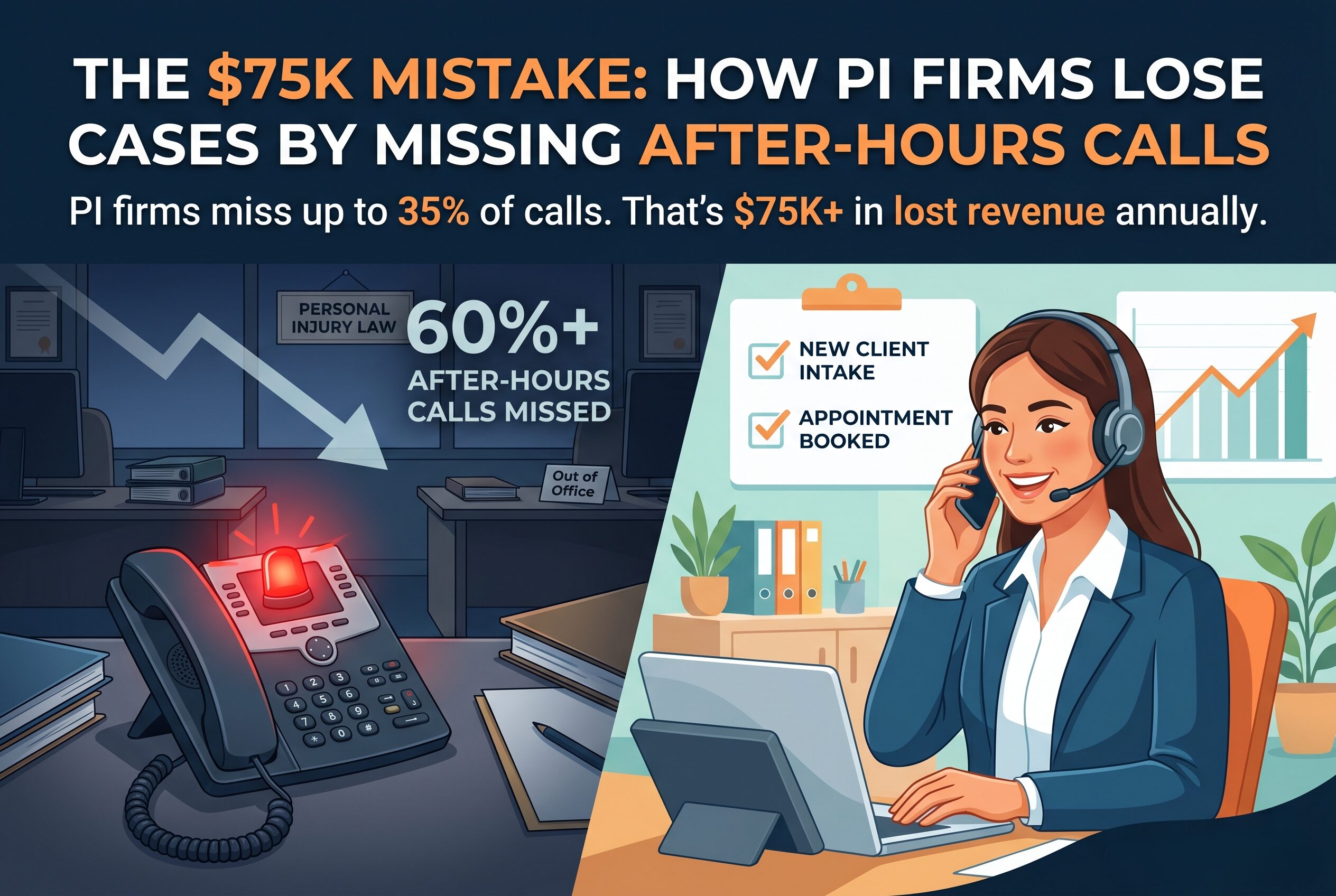
Industry data paints a stark picture. According to Clio's Legal Trends Report, law firms miss approximately 35% of incoming calls during regular business hours. After hours, that number climbs to 60% or higher. And roughly 80% of callers who reach voicemail hang up without leaving a message.

For most practice areas, a missed call is an inconvenience. For personal injury firms, it's a direct revenue loss measured in tens of thousands of dollars.

35%
of calls missed during business hours (Clio Legal Trends)
60%+
of after-hours calls go unanswered at most PI firms
80%
of callers hang up when they reach voicemail

Why PI Missed Calls Hit Harder Than Any Other Practice Area

Personal injury has a unique combination of factors that make missed calls especially costly.

Case values are high

The average PI case value ranges from $15,000 to $50,000, with catastrophic injury, trucking accidents, and medical malpractice cases reaching well into six figures. A single missed call doesn't cost you $200 — it can cost you $15,000 or more in lost fees.

PI callers decide fast

Someone who was just rear-ended at a red light isn't filling out a web form and waiting 48 hours. They're picking up the phone, calling two or three firms, and retaining the first one that answers. Research consistently shows that 62% to 78% of legal clients hire the first attorney who responds to their inquiry.

PI callers don't leave voicemails

These are people calling from hospital waiting rooms, accident scenes, or their kitchen table at 9 PM after a bad day. They're stressed, emotional, and looking for someone who can help right now. Voicemail doesn't feel like help. It feels like being ignored.

The calls come at the worst times

Accidents don't follow a 9-to-5 schedule. Car crashes happen during evening commutes. Slip-and-falls happen on weekends. The calls that follow come during evenings, weekends, and holidays — precisely when most PI firms have zero phone coverage.

"Your marketing dollars generated the lead. Your competitor answered the phone. Your competitor signed the client."

The Revenue Math Most Firms Never Run

Let's put real numbers to this. Take a PI firm that receives 40 inbound calls per week. If 35% go unanswered, that's 14 missed calls per week. Now, not every call is a qualified lead — let's say 35% of those missed calls were genuine prospects. That's roughly 5 qualified intake calls lost per week.

📊 The Revenue Calculation
5 missed calls / week
× 25% consultation-to-client conversion rate
× $15,000 average case value
= $18,750 / week in potential lost revenue
$75,000+ in lost annual revenue — using conservative numbers

At higher case values — common in catastrophic injury and medical malpractice — the exposure is significantly greater. A single missed call on a $100,000 case is worth more than an entire year of answering service costs.

The most painful part? Most firms have no idea this is happening. They track ad spend, click-through rates, and website traffic — but they don't track how many inbound calls went unanswered and what those calls were worth.


The After-Hours Gap Is Where Most Revenue Leaks

If your firm closes at 5 PM and doesn't reopen until 9 AM, you're dark for 16 hours — two-thirds of every day. Add weekends and holidays, and you're unavailable for roughly 75% of the total hours in a year.

75%
of the year your firm is unreachable after hours
#1
attorney retained is the first one who picks up the phone

Now consider when accidents actually happen: evening commute crashes, weekend slip-and-falls, late-night DUI incidents. A potential client who's been in a car accident at 7 PM on a Thursday isn't going to leave a voicemail and wait for a callback. They're going to call the next firm on Google. And by the time your office opens Friday morning, they've already spoken with two other attorneys — and may have signed a retainer.

Your Ad Spend Funds Your Competitor's New Client

Here's where missed calls become a compounding problem. PI firms invest heavily in advertising to generate inbound calls. Google Ads for personal injury keywords can cost $50 to $200+ per click. Television spots run thousands per month. Referral fees add up.

All of that spend is designed to make one thing happen: the phone rings. But if nobody answers that call, the entire investment is wasted — and worse, it's wasted in a way that directly benefits your competitor.

You didn't just lose a case. You paid for your competitor to win one.


Is Your Firm Leaking Revenue After Hours?

PI firms miss up to 35% of calls during business hours — and 60%+ after hours. Here's the fix.

Explore Our PI Answering Service → No obligation. No sales pitch. Just clarity on where your call handling fails — and how to fix it.

The Fix Isn't Complicated

The solution to this problem isn't hiring more staff or working longer hours. It's ensuring that every inbound call reaches a live person who can capture intake details and book a consultation — regardless of when it comes in.

A personal injury answering service provides exactly this. Trained receptionists answer in your firm's name, capture accident details, medical treatment status, insurance information, and urgency factors, and book consultations directly into your calendar. The potential client hangs up with a confirmed appointment before they ever think about calling another firm.

The cost of this coverage is a fraction of what a single missed case would have been worth. For most PI firms, the answering service pays for itself within the first week of operation — often with a single recovered call.

"The question isn't whether your firm can afford an answering service. It's whether you can afford to keep missing the calls you're already paying to generate."

What to Do Right Now

If you're running a PI firm and you're not sure how many calls you're missing, start by auditing your phone system. Pull call logs for the past 30 days and look at:

  • How many calls came in after hours
  • How many went to voicemail
  • How many voicemails were never returned

The numbers will likely surprise you. And once you see them, the math speaks for itself.

Book a Free Intake Audit

We'll show you exactly where your PI calls are falling through — and what it's costing you.

Book My Free Audit → Takes less than 15 minutes. No commitment required.
🕒 Last updated: May 2026