
Shared answering services solve the coverage problem. A dedicated receptionist solves the familiarity problem — and for many law firms, that's the one that actually costs them clients.
A law firm reached out to us recently through a legal software directory, and the first thing they said set the tone for the entire conversation. They were not shopping for an answering service. They had used answering services before. What they wanted was one person who actually knew their firm.
That distinction sounds small. It is not. And the more conversations we have with firms, the clearer it becomes that a meaningful slice of the legal market has quietly moved past the question of whether their phones get answered, and on to a harder question: who is answering, and what do they know?
The traditional case for a law firm answering service is coverage. Attorneys are in court, in depositions, in client meetings, and a live receptionist makes sure a potential client never hits voicemail. That case is still true, and for many firms a shared live answering team is exactly the right solution at the right price.
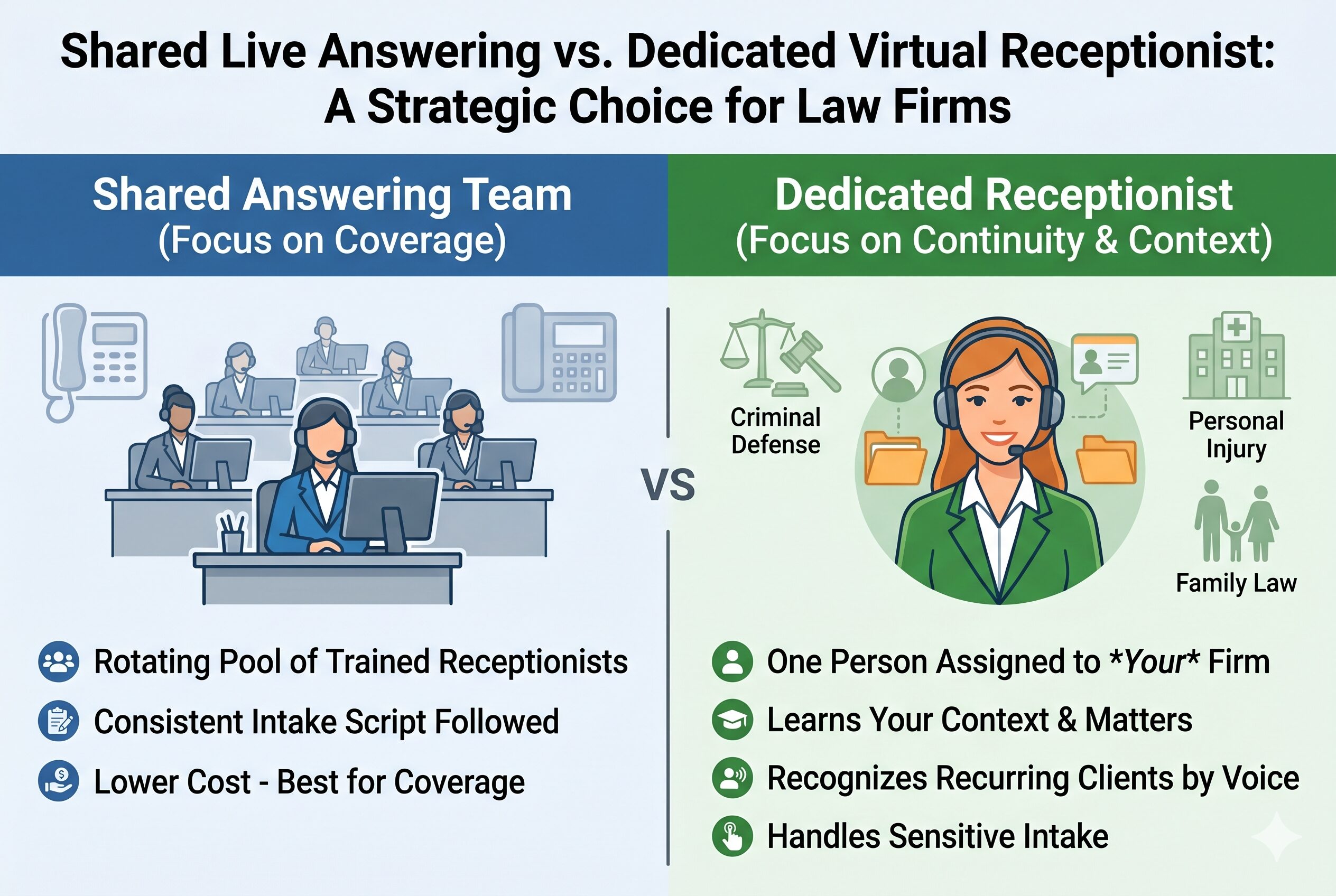
But coverage solves the first problem and exposes the second. When your calls are answered by a rotating pool of receptionists, every caller meets a stranger. The receptionist can follow your intake script, but she cannot recognize your existing client by voice, remember that a particular matter is sensitive, or know that Tuesday afternoons are blocked for depositions without checking notes. The phones are covered. The familiarity is not.
For firms where a single new matter can be worth tens of thousands of dollars, that gap shows up in real ways. Intake questions answered slightly differently from call to call. Existing clients re-explaining who they are. Attorneys filling in context after the fact. Nothing is technically dropped, and yet the firm's front line never gets better at being that firm's front line.
What a Dedicated Receptionist Actually Changes
A dedicated virtual receptionist is one specific person assigned exclusively to your firm. She is trained on your practice areas, your intake questions, your scheduling rules, your conflict check basics, and your preferences for how messages reach each attorney. She answers your calls personally, every day, and over time she becomes something a shared pool can never become: a familiar voice your clients recognize.
And your attorneys stop spending the first five minutes of every callback reconstructing what happened on the initial call.
The model works because it borrows the best part of an in-house hire — continuity — without the parts that make firms hesitate: salary, benefits, payroll taxes, training time, and the risk that your trained receptionist leaves in a year and the cycle starts over.
And when a dedicated receptionist is paired with a live team behind her, the firm gets something an in-house hire can never offer alone: true 24/7/365 coverage. Your receptionist handles your calls during the day, and the live team picks up nights, weekends, and holidays with the same account instructions.
Shared vs. Dedicated: An Honest Comparison
Neither model is universally better, and any provider who tells you otherwise is selling, not advising. Here is how the two options actually stack up.
Right for coverage-first firms
- → Rotating pool of trained receptionists
- → Follows your intake script consistently
- → Lower cost — predictable flat rate
- → Best for modest call volume
- → Straightforward intake processes
- → Solo attorneys and small firms
Right for continuity-first firms
- ✓ One person, exclusively your firm
- ✓ Learns clients, matters, and preferences
- ✓ Recognizes returning callers by voice
- ✓ Handles sensitive intake with context
- ✓ Backed by live team for 24/7 coverage
- ✓ High-volume or high-value practices
| Factor | Shared Team | Dedicated Receptionist |
|---|---|---|
| Caller recognition | Every call is a first meeting | Returns callers recognized by name |
| Intake consistency | Script-based, varies by agent | Same person, same standard, every time |
| Practice area knowledge | General legal training | Trained on your specific practice areas |
| After-hours coverage | Included via shared pool | Live team covers nights & weekends |
| Attorney follow-up time | Often requires re-briefing | Full context handed off immediately |
| Cost model | Lower — flat monthly plans | Higher — reflects dedicated capacity |
| Best fit | Solo / small firm, simple intake | High-volume, sensitive, or repeat-client matters |
Which Practice Areas Reach This Point Earliest
Family law, personal injury, and criminal defense practices tend to benefit from a dedicated receptionist sooner than most, because their callers are often stressed, their intake is sensitive, and a familiar, steady voice is part of the service itself.
These practice areas share a common thread: the caller's first contact with your firm is emotionally loaded. A shared receptionist who follows a script can capture the intake. A dedicated receptionist who knows the firm can begin building trust on that first call — and every call after it.
For practices where strong legal intake support is the difference between a signed retainer and a lost lead, the case for continuity compounds quickly.
How to Know If Your Firm Is Ready
A few honest signals from the firms we talk to. These are not upsells — they are the things that consistently come up when firms describe why they made the switch.
-
Your team re-explains call handling instructions more than once a quarter. If onboarding a shared service feels like a recurring task, the model isn't holding what you're putting into it.
-
Your attorneys regularly redo intake questions because the first pass missed something. This is the cost of inconsistency, measured in attorney time.
-
Existing clients have commented on reaching someone new every time. This is not a small thing in legal. Clients who feel like a stranger every time they call are clients who start wondering if another firm might know them better.
-
You have considered hiring an in-house receptionist but the fully loaded cost stopped you. A dedicated virtual receptionist delivers continuity without salary, benefits, payroll taxes, or turnover risk.
-
Your call volume is high enough to keep one person meaningfully busy. If your receptionist would be idle, a shared team is the smarter allocation. If she would be busy, she is earning her keep every hour.
The answering service industry spent decades training law firms to accept interchangeable voices as the price of coverage. What firms are telling us now is that coverage has become table stakes, and familiarity is the upgrade.
The firm that reached out through that directory listing understood it instinctively: continuity is the product, and the phone answering is just the delivery mechanism.
If your firm is weighing the move, the simplest next step is a conversation about how your calls are handled today. We will tell you honestly whether a dedicated receptionist makes sense for your volume, or whether a standard plan covers you just as well.
Talk to Our Team About Your Firm
We'll look at your call volume, your intake process, and your practice areas — and give you an honest answer about which model fits.
No credit card required · No obligation · Month-to-month