

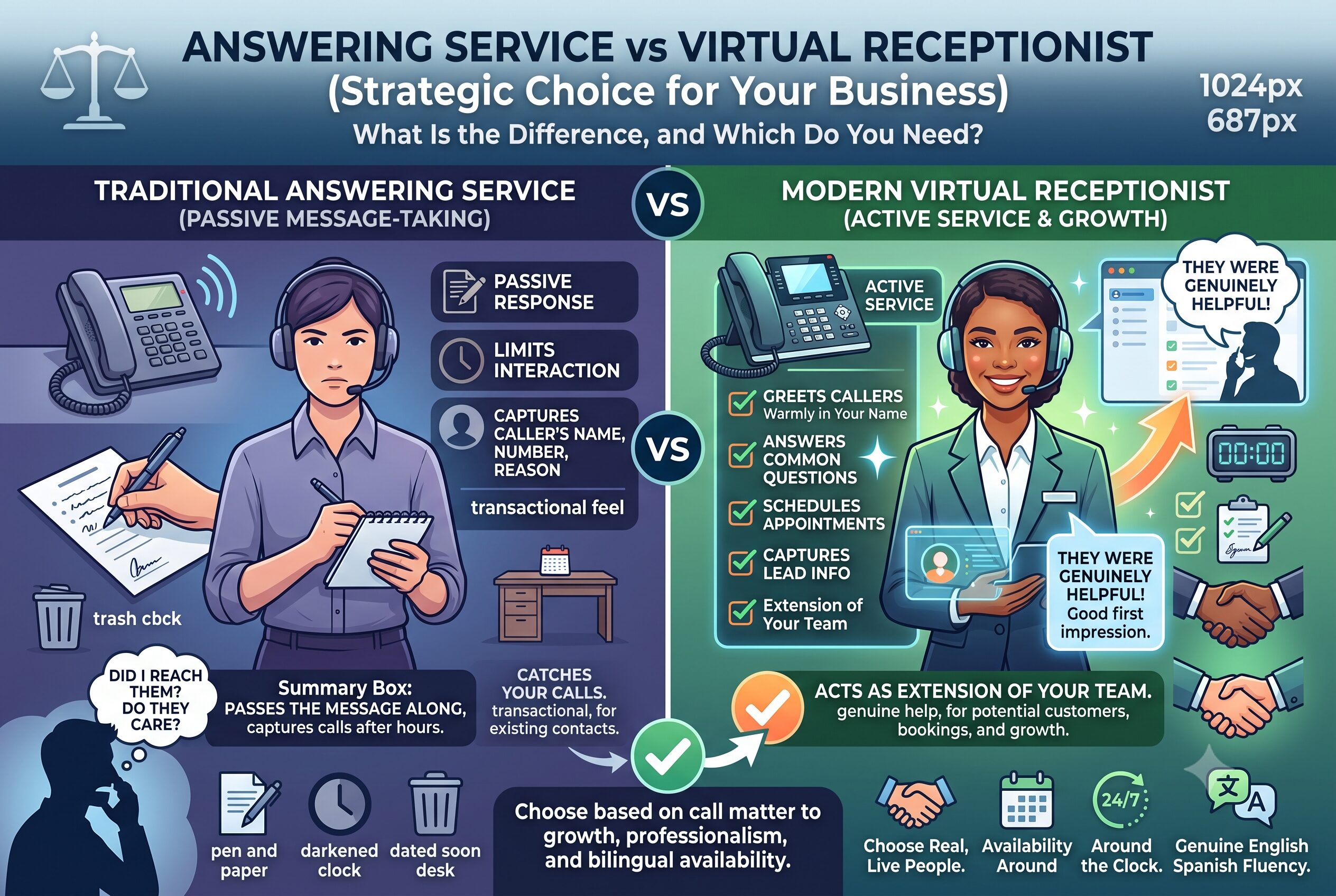
Answering Service vs Virtual Receptionist: What Is the Difference, and Which Do You Need?
The two terms get used interchangeably, but they are not the same thing, and picking the wrong one can quietly cost you customers.
An answering service takes a message. A virtual receptionist greets the caller, answers questions, and books the appointment, turning the call into business instead of just a note on your desk.
If you have started looking into help with your business phone calls, you have probably run into two terms that seem to be used interchangeably: answering service and virtual receptionist. They sound similar, and some companies blur the line between them. But there are real differences, and understanding them helps you choose the right kind of support for your business.
Answering service vs. virtual receptionist: the real difference
A traditional answering service has been around for decades. At its most basic, it answers calls when you cannot and takes messages. A virtual receptionist does much more, acting as an extension of your team rather than a simple message-taking service.
Answering Service
- → Answers calls when you cannot and takes a message
- → Works well if you only need after-hours messages caught
- → Largely passive — captures the call but does not act on it
- → Callers often know they have reached a message service, which can feel transactional
Virtual Receptionist
- ✓ Greets callers warmly in your business name
- ✓ Answers common questions and screens and routes calls
- ✓ Schedules appointments and captures lead information
- ✓ Handles the caller the way a great in-house receptionist would
The difference is the level of service and the impression it creates. To your caller, it feels like they reached your business and were genuinely helped, not like they were shuffled off to a message service.
Which one does your business need?
The right choice depends on what you want your callers to experience and how much you rely on those calls to grow.
If your calls are mostly existing contacts and you just need messages captured after hours, a basic answering service may be enough. But if your incoming calls are potential customers, if first impressions matter, and if you want calls handled, booked, and turned into business rather than just noted down, a virtual receptionist is the better fit.
For most growing businesses, especially those where a phone call is often the first step toward becoming a customer, the virtual receptionist model delivers far more value. Every call is an opportunity, and a virtual receptionist is built to make the most of each one.
What to look for either way
Whatever level of service you choose, a few things separate a great provider from a mediocre one.
-
Real, live people, not automated systems. Callers can tell the difference, and it affects whether they trust your business.
-
Genuine availability around the clock. The most important calls often come outside business hours.
-
True bilingual fluency in English and Spanish, not just a translation line, if you serve a diverse community, so every caller feels understood.
An answering service catches your calls. A virtual receptionist catches your calls and turns them into opportunities. For businesses where the phone is a front door to new customers, the difference is significant. Choose based on how much those calls matter to your growth, and choose a provider that answers with real, capable, and genuinely helpful people.
Gabbyville is a live virtual receptionist service that does far more than take messages. Real, US-based, fluently bilingual receptionists greet your callers, book appointments, and capture every opportunity, 24/7, with over 20 years of experience. Start a free trial and hear the difference.
Hear the Difference for Yourself
See what a real virtual receptionist service sounds like, and how many more calls it turns into customers.
No credit card required · No obligation · Month-to-month