

The Real Cost of an In-House Receptionist in 2026
Salary is only the start. Once benefits, turnover, and coverage gaps are counted, an in-house receptionist costs far more than most businesses expect. Here's the full 2026 breakdown.
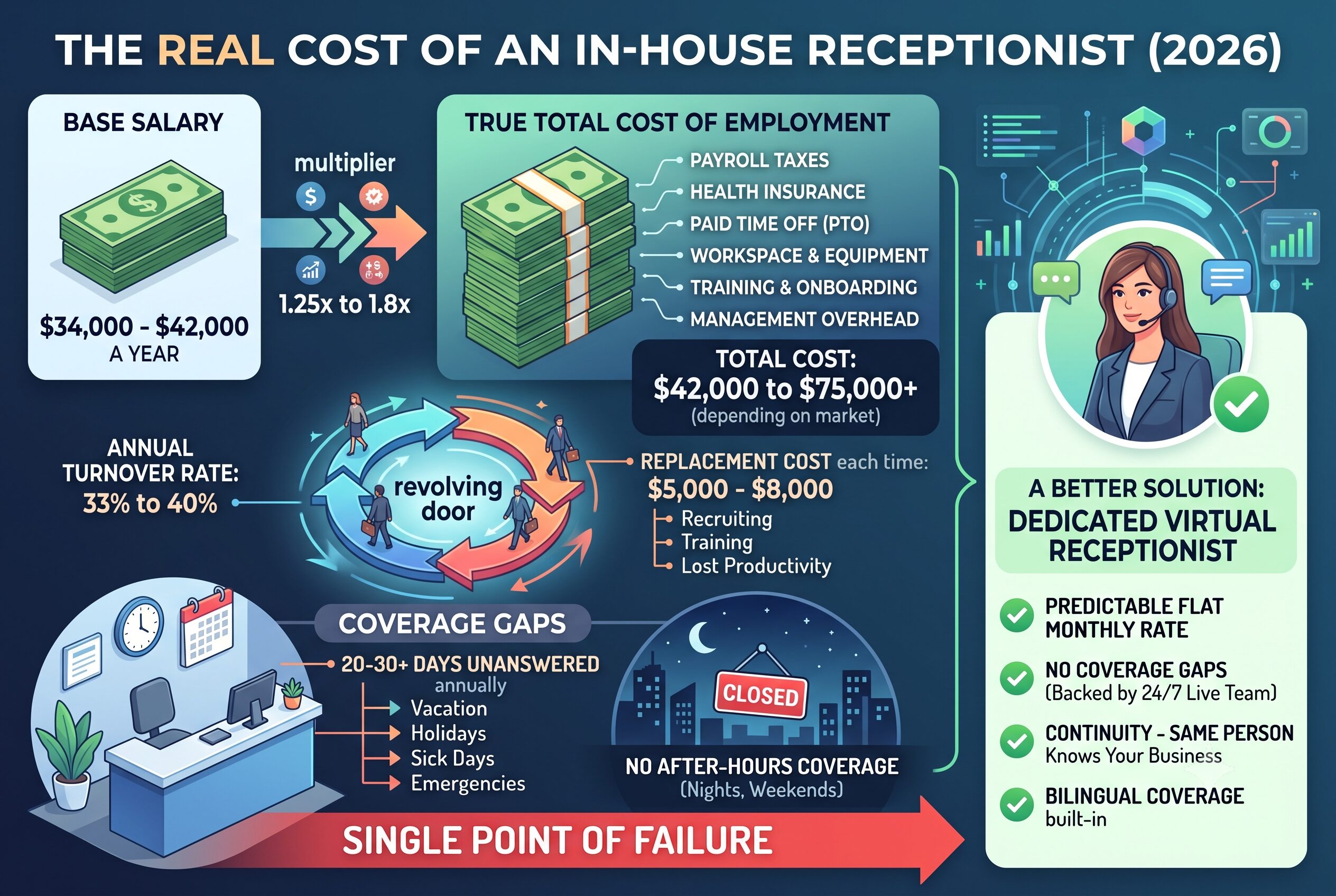
Most business owners know what a receptionist's salary looks like. What surprises them is everything hiding underneath it. When you add up benefits, payroll taxes, turnover, and the days the phone simply goes unanswered, the true cost of an in-house receptionist runs far higher than the number on the job offer.
For a lot of small and midsize businesses, it is one of the most underestimated expenses on the books.
If you are weighing whether to hire a front-desk person or handle your calls another way, it is worth seeing the full picture first. Here is what an in-house receptionist actually costs in 2026 — and why more businesses are rethinking the model entirely.
Salary is only the beginning
The base salary for a receptionist in the United States generally falls in the range of $34,000 to $42,000 a year, and climbs higher in major metro markets like New York, San Francisco, and Boston. But base salary is only part of what an employer pays. According to workforce cost benchmarking, the true total cost of an employee typically runs 1.25 to 1.8 times their base salary once you include everything the role really requires.
That total includes payroll taxes, health insurance, paid time off, workspace and equipment, training, and the management overhead of supervising the role. Add it all up and a receptionist earning a mid-thirties base salary can cost a business anywhere from $42,000 to more than $60,000 a year. In high-cost cities, total employment cost commonly reaches $55,000 to $75,000. The salary line on the offer letter tells you less than half the story.
Payroll taxes, health insurance, paid time off, workspace and equipment, onboarding and training, plus the management time it takes to supervise the role. These are real, recurring costs that never appear on the offer letter — yet they can add 25 to 80 percent on top of base salary.
The turnover problem nobody budgets for
Receptionist roles have among the highest turnover rates of any occupation. Roughly one in three receptionists leaves within a year, with annual turnover commonly landing between 33 and 40 percent. Every departure restarts the clock: job postings, interviews, onboarding, and the slow ramp-up while a new hire learns your business. Each replacement is estimated to cost between $5,000 and $8,000 once you account for recruiting, training, and lost productivity during the vacancy.
For a business that relies on its phone, turnover is not just a cost. It is a recurring disruption. Every time the person at the front desk changes, your callers meet a stranger who does not yet know your clients, your processes, or your priorities. The institutional knowledge walks out the door and has to be rebuilt from scratch.
At 33 to 40 percent annual turnover, a business can expect to replace its receptionist roughly every two to three years — and often sooner. At $5,000 to $8,000 per replacement, that is a recurring line item most owners never build into the budget.
The days your phone goes unanswered
Even a great in-house receptionist cannot be in two places at once, and cannot be at the desk every hour your business might get a call. The average full-time employee receives 10 to 15 days of paid vacation plus 6 to 8 paid holidays each year. On top of that, unscheduled absences for sick days and emergencies average another 4 to 6 days annually.
Put together, that is roughly 20 to 30 or more days a year when your receptionist is not there — and you are still paying full salary while either going without phone coverage or paying again for a substitute. And none of that touches evenings, early mornings, or weekends, when many of your most valuable calls actually come in. One person, one desk, one set of hours is a single point of failure for something as important as every inbound call.
10–15 vacation days
Paid time off is standard — and the desk still needs covering while it's used.
6–8 paid holidays
Your customers may still be calling, but no one is at the front desk.
4–6 unscheduled absences
Sick days and emergencies are unavoidable — and impossible to plan around.
Zero nights & weekends
After-hours calls go unanswered unless you hire and pay for even more coverage.
Add it up: the true annual cost
Here is the honest total for an in-house receptionist in 2026:
| Cost factor | 2026 range | The catch |
|---|---|---|
| Total employment cost | $42,000–$75,000/yr | Depends on market; 1.25–1.8× base salary |
| Turnover | $5,000–$8,000 each | 33–40% leave annually; recurring disruption |
| Coverage gaps | 20–30+ days/yr | Paid in full while the desk sits empty |
| After-hours coverage | Not included | No nights or weekends without hiring more |
| Real, fully loaded cost | $42,000–$75,000+/yr — and climbing with every hire and gap | |
Figures are ranges based on 2026 US Bureau of Labor Statistics and SHRM total-employment-cost benchmarking. Your actual costs will vary by market, role, and coverage requirements.
Once you see it laid out, the salary figure looks almost quaint. The real cost is a moving target that goes up every time someone quits and leaves a gap every time someone takes a day off.
Why more businesses are choosing a dedicated receptionist instead
This is exactly why a growing number of businesses are moving to a dedicated virtual receptionist rather than hiring in-house. The idea is simple: you get one dedicated professional assigned to your business, someone who learns your processes and answers your calls the way an employee would — but without the salary, benefits, turnover, or coverage gaps of an in-house hire.

The economics are hard to argue with. Instead of a $42,000 to $75,000 all-in cost that fluctuates with turnover, you get one predictable monthly rate. Instead of losing coverage 20 to 30 days a year, you get support that never takes a day off, backed by a live team around the clock. And instead of retraining a new face every year, you keep the same dedicated person who actually knows your business. For businesses that serve Spanish-speaking clients, bilingual coverage comes built in rather than as a hard-to-fill hiring requirement.
One predictable rate
A flat monthly plan instead of a fluctuating, fully loaded salary.
Never off the clock
Live coverage around the clock — no vacation, holiday, or sick-day gaps.
No turnover churn
Keep the same familiar professional instead of retraining every year.
Bilingual built in
English and Spanish coverage included — no hard-to-fill hiring requirement.
None of this means hiring in-house is always the wrong call. For some businesses with the volume and the budget, a full-time employee at the front desk makes sense. But for many small and midsize businesses, the dedicated model delivers the continuity of an employee at a fraction of the true cost, with none of the coverage gaps. If you have been weighing the two, it is worth comparing our flat monthly plans against the real, fully loaded cost of a hire.
Get the result of an employee — without the true cost of one
Talk to our team about a dedicated virtual receptionist, or start a free trial and hear what live, U.S.-based coverage sounds like for your business.
Plans from $299/month · Month-to-month · Cancel anytime
The bottom line
An in-house receptionist costs far more than their salary. Between total employment cost, chronic turnover, and the days the desk sits empty, the real number is $42,000 to $75,000 a year and climbing, with gaps built in. Before you post that job opening, it is worth asking whether what you actually need is an employee, or simply the result an employee would deliver. Increasingly, businesses are deciding they can get that result for less — and without the headaches — by going dedicated instead.
Frequently asked questions
Base salary generally falls between $34,000 and $42,000 a year, but the fully loaded cost typically runs 1.25 to 1.8 times that once you add payroll taxes, benefits, paid time off, equipment, training, and management overhead. That puts the real total at roughly $42,000 to $75,000 a year, with high-cost cities commonly reaching $55,000 to $75,000.
Receptionist roles have among the highest turnover rates of any occupation. Roughly one in three receptionists leaves within a year, with annual turnover commonly landing between 33 and 40 percent. Each replacement is estimated to cost between $5,000 and $8,000 once you account for recruiting, training, and lost productivity during the vacancy.
Between 10 to 15 vacation days, 6 to 8 paid holidays, and 4 to 6 unscheduled sick or emergency days, an in-house receptionist is typically away from the desk roughly 20 to 30 or more days a year. That is on top of every evening, early morning, and weekend that falls outside their working hours.
For many small and midsize businesses, yes. Instead of a $42,000 to $75,000 all-in cost that fluctuates with turnover, a dedicated virtual receptionist gives you one predictable monthly rate, no coverage gaps, and a live team available around the clock, with bilingual English and Spanish support built in.
No. A dedicated virtual receptionist is one professional assigned to your business who learns your processes and answers your calls the way an employee would. You keep the same familiar person instead of retraining a new face every year, and a live team backs them up so calls are never missed.
Last updated: July 2026
Source note: Cost figures based on 2026 US Bureau of Labor Statistics (BLS) and SHRM total-employment-cost data. Figures are presented as ranges; actual costs vary by market, role, and coverage requirements.