
The virtual receptionist market has exploded. In 2026, there are dozens of AI-only answering services promising 24/7 coverage for as little as $29 per month. On the other end, live human receptionist services charge $250 to $1,000+ per month for trained agents who answer in your firm's name.
Law firms trying to decide between the two are asking the wrong question.
The real question isn't "AI or human?" It's "what does my caller actually need in the first 60 seconds of contact — and which solution delivers it?" The answer, for most law firms, is neither pure AI nor live-only. It's both, working together.

The best-performing law firms in 2026 aren't choosing between AI and human — they're using both.
Where Pure AI Excels
AI receptionist technology has improved dramatically. Modern AI receptionists sound natural, understand conversational language, and can handle straightforward tasks with impressive reliability.
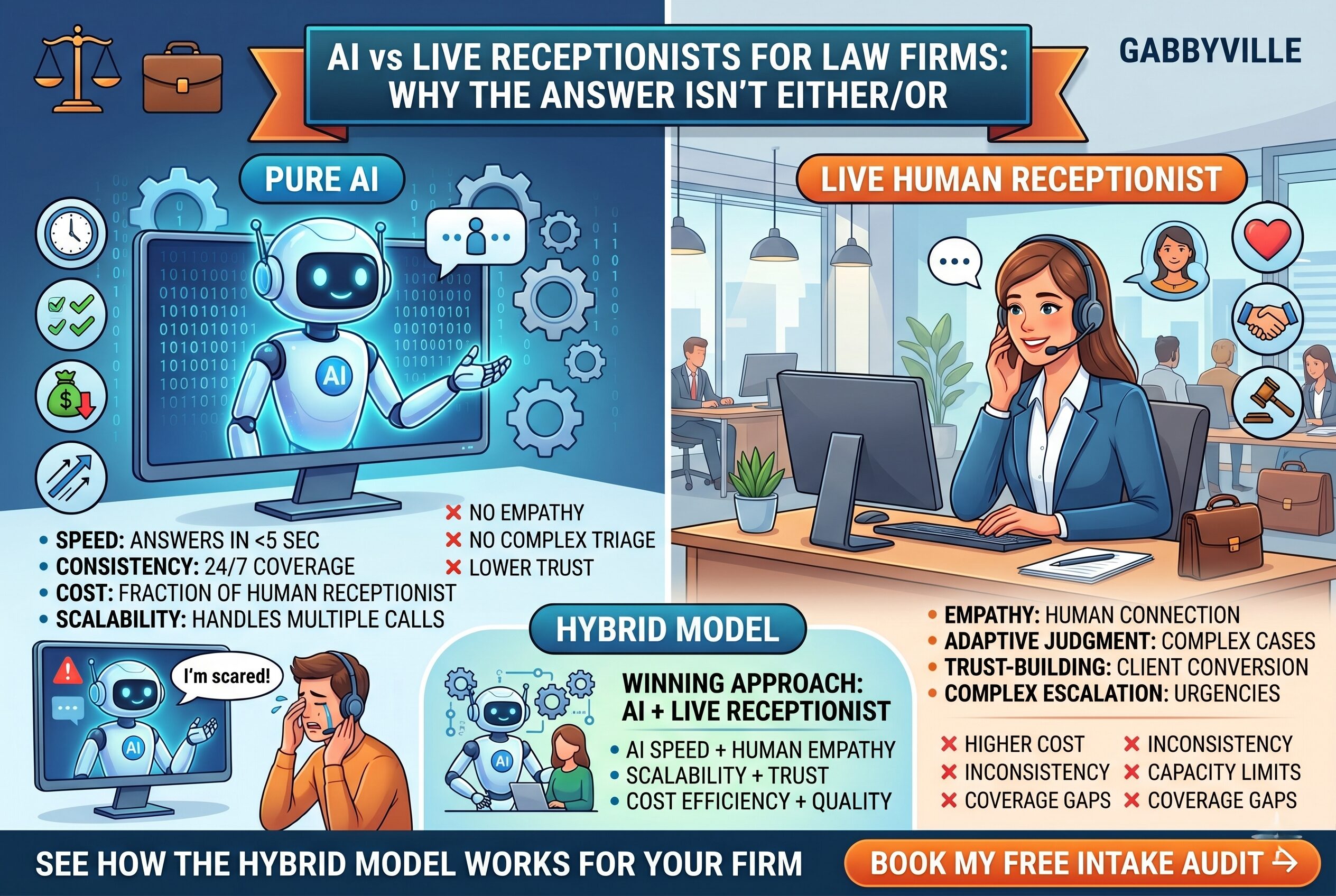
- Speed. Answers in under 5 seconds, every time. No hold music, no ringing.
- Consistency. Never has a bad day, never calls in sick, never rushes a 4:55 PM call.
- Cost. $29–$199/month for unlimited calls — a fraction of human receptionist cost.
- Scalability. Handles 20 simultaneous calls as easily as one. No busy signals, ever.
- Empathy. Callers in crisis can tell the difference between scripted and genuine care.
- Complex triage. AI follows its script — it can't hear urgency or make real-time judgment calls.
- Trust. 84% of legal clients want to speak to a real person, not a bot.
- Edge cases. The unpredictable 20% — crying callers, multi-party situations, ESL clients — breaks AI down.
Where Pure AI Fails — In Detail
Despite these strengths, pure AI has critical limitations that matter enormously in legal intake.
Research shows that 84% of legal clients want to speak to a real person, not a bot. That first phone call is where trust is built or lost. For criminal defense, family law, and personal injury — the human connection in those first 60 seconds can determine whether a prospect becomes a client.
A parent calling at midnight because their 19-year-old was just arrested doesn't need efficient data collection. They need to hear a calm, human voice that acknowledges their fear and guides them through what happens next. AI can simulate empathy through scripted phrases, but callers in crisis can tell the difference — and many will hang up.
And in law, that unpredictable 20% often represents your highest-value cases.
Where Live-Only Falls Short
If pure AI has empathy problems, live-only services have operational ones.
- Cost. Starts at $250/month, can exceed $1,000/month for comprehensive legal intake.
- Inconsistency. Humans have bad days. One caller gets thorough intake; the next gets someone rushing.
- Capacity limits. One call at a time. During peak periods, calls stack up — exactly the problem you hired them to solve.
- Coverage gaps. Many services charge premium rates for after-hours, or don't offer it at all.
- Empathy. Real humans hear urgency, respond to emotion, and build trust instantly.
- Adaptive judgment. Can handle any situation, not just the predictable ones.
- Trust-building. The human connection that converts a scared caller into a signed client.
- Complex escalation. Can make real-time decisions about warm transfers and urgency.
The hybrid model assigns each part of the intake process to whatever handles it best.
The Hybrid Model: Why the Best Firms Use Both
The firms getting this right in 2026 aren't choosing between AI and human. They're using both in a coordinated system where each handles what it does best.
In a hybrid AI + human model, AI handles the structured, repeatable parts of intake. Human receptionists handle what AI can't — empathy in crisis calls, complex triage decisions, warm transfers, and the emotional reassurance that turns a scared caller into a trusting client.
The handoff between AI and human is seamless. The caller never knows (or cares) which parts were handled by which. They just experience a fast, professional, empathetic intake process that ends with a booked consultation.
The Hybrid Model Delivers
- AI speed — every call answered in seconds, 24/7, no hold time
- Human empathy — sensitive calls handled by trained receptionists
- Consistent quality — AI handles the structured parts the same way every time
- Scalability — AI absorbs volume spikes without degraded service
- Cost efficiency — human time is reserved for the calls that actually need it
See How the Hybrid Model Works for Your Firm
Book a free intake audit and we'll show you exactly how AI + live receptionists can work together for your specific practice area.
Book My Free Intake AuditNo obligation. No sales pitch. Just clarity on what your firm actually needs.
Which Practice Areas Need Which Approach?
Not every call requires the same level of human involvement. Here's how it typically breaks down by practice area:
| Practice Area | Human Need | Recommended Approach |
|---|---|---|
| Criminal Defense | Highest | AI for initial pickup & identification; humans handle all substantive intake and warm transfer to attorney |
| Personal Injury | High | Human for serious injury calls; AI can handle general inquiries with escalation available |
| Family Law | High | Human receptionists essential for initial intake; AI supports scheduling and follow-up |
| Estate Planning | Moderate | AI can handle a larger share; human involvement for complex or high-value matters |
| Business Law | Lower | AI handles most intake efficiently; humans for escalated or sensitive matters |
How to Evaluate an Answering Service in 2026
If you're comparing services, here are the five questions every law firm should ask before signing up:
-
Ask about the handoff. How does the system decide when to escalate from AI to human? Is it automatic based on keywords like "arrested" or "emergency," or does it require the caller to navigate a menu? The best systems use intelligent routing that doesn't require caller effort.
-
Ask about legal training. Generic answering services treat every call the same. A law firm answering service should have receptionists who understand legal terminology, know not to give legal advice, and can handle emotionally charged conversations.
-
Ask about bilingual capability. Over 41 million Americans speak Spanish. If the service doesn't offer bilingual intake, you're leaving a significant portion of your market to competitors who do.
-
Ask about coverage hours. "24/7" should mean 24/7 — not "business hours with after-hours voicemail." Verify exactly what happens when a call comes in at 2 AM on a Saturday.
-
Ask about integration. Can the service book directly into your calendar? Does it integrate with your CRM or practice management software? If you're manually re-entering data from call summaries, you're adding friction that slows down your intake.
The Bottom Line
Pure AI is cheap but fails when it matters most. Live-only is reliable but expensive and limited. The hybrid AI + live receptionist model — AI speed backed by human judgment — is what the fastest-growing law firms are adopting in 2026.
The firms winning clients aren't the ones with the most attorneys or the biggest ad budgets. They're the ones who answer every call, handle it with professionalism and empathy, and book the consultation before the caller ever thinks about dialing another number.
See the Hybrid Model in Action for Your Firm
Book a free intake audit to see how a hybrid AI + live receptionist model would work for your firm's specific practice areas and call volume.
Book My Free Intake Audit →15–20 minutes · No obligation · No long-term contracts
Last updated: May 2026