
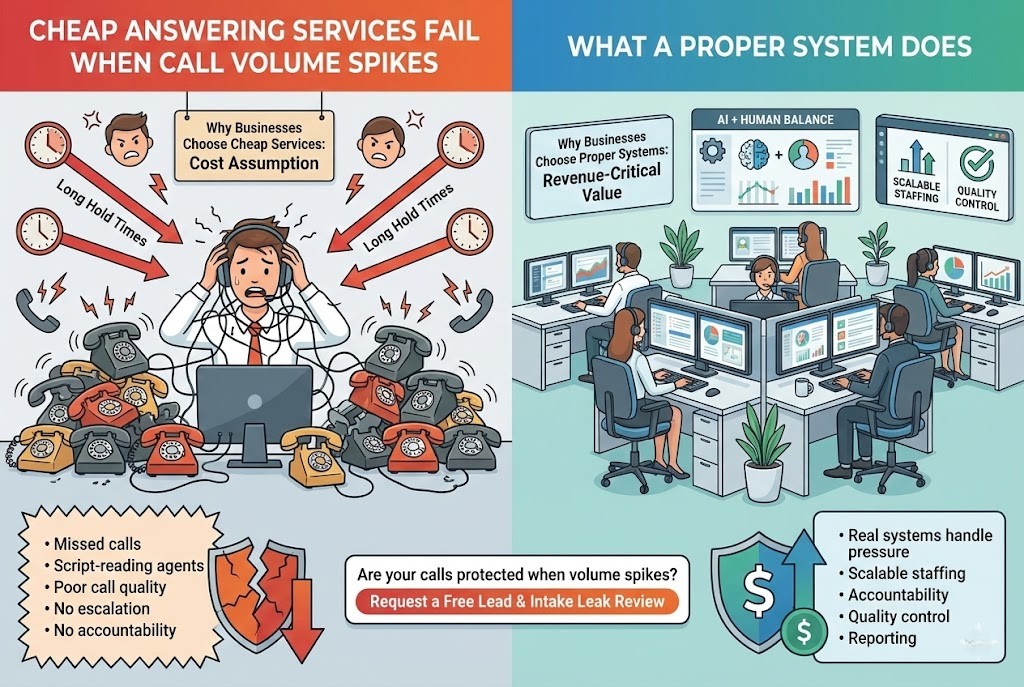
Most businesses choose cheap answering services for one reason only: cost.
There’s an assumption that answering is answering, and calls don’t carry intrinsic value. That assumption is where things quietly break.
Why businesses choose cheap services:
They believe all answering services are the same, see it as temporary, or don’t view calls as revenue-critical.
Are Your Calls Protected When Volume Spikes?
No obligation. No sales pitch. Just clarity on where your call handling fails—and how to fix it.
What happens when volume increases:
Call volume spikes during marketing campaigns, growth, seasonal demand, or emergencies. The first thing to break is coverage.
Where cheap services fail:
Long hold times
Missed calls
Script-reading agents
Poor call quality
No escalation
No accountability
How this shows up:
Leads go cold, callers get frustrated, reviews suffer, and owners wonder why marketing stops working.
Why businesses tolerate it:
Cheap services lower expectations, so poor performance is tolerated longer than it should be.
What a proper system does:
Real systems handle pressure with scalable staffing, accountability, quality control, reporting, and AI + human balance.
Who this is not for:
Businesses are chasing the lowest price, not tracking leads, or treating calls as a nuisance.
Are Your Calls Protected When Volume Spikes?
No obligation. No sales pitch. Just clarity on where your call handling fails—and how to fix it.